The Punjab
Geography
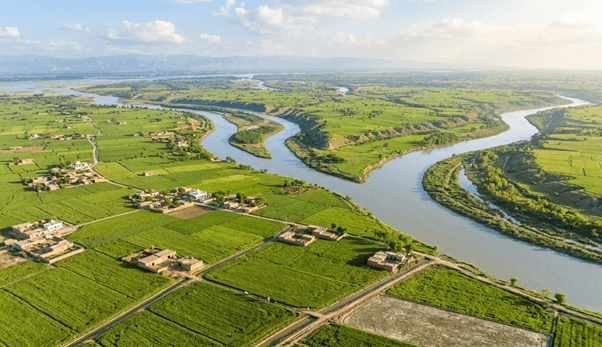
Historically known as the 'Land of Five Rivers,' the Punjab forms a vast, fertile plain in the northwestern part of the Indian subcontinent, bordered by the Himalayan foothills to the north and the Thar Desert to the south. Its geography is shaped by the Indus River system, primarily its five major tributaries—the Jhelum, Chenab, Ravi, Beas, and Sutlej—which flow southwest to create distinct strips of land between the rivers known as doabs. Over thousands of years, rich soil deposited by these snow-fed Himalayan rivers turned the basin into one of the world's best farming regions, marked by flat land, a climate of extreme summer heat and cool winters, and an extensive network of historic canals that connected the entire region.
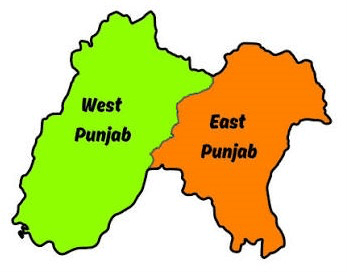
Following the 1947 Partition, the western portion became Pakistani Punjab, covering roughly two-thirds of the original region and including the lower stretches of the Indus, Jhelum, Chenab, and Ravi rivers. West Punjab's landscape shifts from the rugged, rain-fed Potohar Plateau and Salt Range in the north to the wide, canal-irrigated flatlands of the central doabs, before gradually meeting the dry Cholistan Desert in the southeast and the Sulaiman Range foothills in the west. Because the major rivers join together toward the Indus in the southwest to form the Panjnad River, West Punjab relies heavily on large dams and link canals to support its dense farmland and major cities like Lahore, Faisalabad, and Multan.
Conversely, the eastern portion became Indian Punjab, a smaller, triangle-shaped plain tucked against the Shivalik Hills in the northeast and bordering the drier plains of Rajasthan and Haryana to the south and east. Watered mainly by the Sutlej and Beas rivers—with the Ravi forming part of its northwestern border—East Punjab is made up largely of the fertile Bist Doab and the wide Malwa and Majha plains. Without the desert plateaus and rugged mountain ranges found in the west, East Punjab has a remarkably flat, uniform landscape and receives slightly more monsoon rain due to its closeness to the outer Himalayas, conditions that helped it become India's leading agricultural hub during the Green Revolution.
Brief History
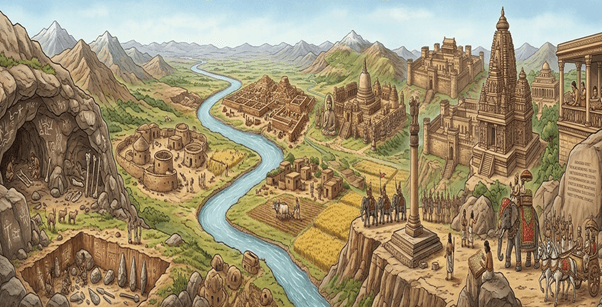
The Punjab has been a cradle of civilizations and possesses a rich historical heritage, from the Soan Valley civilization to the Indo-Gangetic agrarian settlements. Harapa and Mohenjo-Daro provide insight into the ancient civilizations and cultures of this region. The remnants of the Gandhara Civilization reveal the influence of the Mauryan and Ashoka empires, which shaped its language, culture and settlement patterns.
The Punjab's language and culture evolved through excessive foreign invasions such as Huns, Kushans, Greeks, Aryans, and among the Muslims, Ghauris, and the Mughals. It received blends of new traditions and cultures with linguistic additions from each foreign invader. Every foreign invasion brought something new to the region that became part of its culture and language. The Greeks did not settle here but the Aariyas and the rest of foreign invaders became part of the society in a couple of centuries after their invasions. The Turko-Afghan invaders brought new religion in Punjab and added more cultural traits in the society than others. Arrival of Sufism and shrine culture triggered a new wave of humane values and indirectly produced Sikhism as modern Punjabi religion. Mughals, Iranians, Turks, and Afghans brought forth material and non-material cultural items to Punjab that changed society in many ways. Living style, architecture, food, attires, and rural-urban settlements witnessed foreign influence from 14th to 17th centuries. The Sikh Empire was the first Punjabi empire in thousand years which combined all communities under a single state slogan. After its annexation by the British, Punjab received new imperial policy of governance in the shape of canal colonies and newly invented landed aristocracy. Moreover, the theory of martial and no martial race also transformed this peaceful region into recruitment grounds for army and Agri-resource producing hub for the British. The partition of India divided Punjab into two parts and at present historical Punjab is divided into Khyber Pakhtunkhwa, Punjab, Chandigarh, and Haryana in Pakistan and India.
Evolution of Punjabi Language
Punjabi as language has its roots into ancient past, middle period, and modern times. The words and writing scripts show its similarities and adaptations from all other languages of the invaders and Indian region. For example, the word "Baranda" is taken from Dutch word "Venranda". Similarly, Persian and Arabic languages also infused many words into Punjabi which are in practice in modern times. Overall, Punjabi language adapted words and writing style from Arabic, Hindi, Sanskrit, Sindhi, Pashto, Balochi, English, Urdu, Dutch, Persian, Turkish and French languages in the past 1000 years. These adaptations have made it a rich language which is understandable in many regions. Recently, Punjabi has recently emerged as the third most widely spoken language in Canada, while it remains widely spoken and understood across India and Pakistan.
Punjabi language evolved through the poetic works of the Sufis, Bhaghats, and through oral story telling. Being the vernacular of the region, it was adopted by the early Sufis as a medium for disseminating their message among the masses. Baba Farid Ganj Shakar and his contemporaries expressed their teachings in Punjabi for the better understanding of the people. Similarly, the Bhaghats used this language in their songs and poetry to express their feelings which later became part of the oral traditions of the language. In 18th Century, Baba Bulleh Shah, Shah Hussain, Mian Mir, and many others contributed to language through their poetry. The holy scripture of Sikhism, the Guru Granth Sahib, is also written in Punjabi which not only played a pivotal role in preserving the language but also made literacy in Punjabi essential for subsequent generations to fulfil their religious obligations.
Sufi works also became an integral part of Punjabi art and literature. Folklores such as Heer Ranjha by Waris Shah (1766/2012) and Saif-ul-Malook by Mian Muhammad Bakhsh became part of music and cultural events in Punjab. Music, art, and dance, as integral components of Punjabi culture, have preserved this language and ensured its continued growth over centuries. Cultural and traditional songs (including tappy, mahiye, dohrhay, waaran, boliyan, and sithniyan) are popular musical ways of expressing sentiments in Punjabi language and culture.
At present, Punjabi is spoken by over 51% of the population in West Punjab (Pakistan Bureau of Statistics, 2023), while the Indian states of Chandigarh and Haryana also have a vast majority of Punjabi speakers. Despite the partition of Punjab in August 1947, the linguistic, cultural, and artistic values on both sides of the border have remained largely intact.
Speech Varieties of Punjabi Language
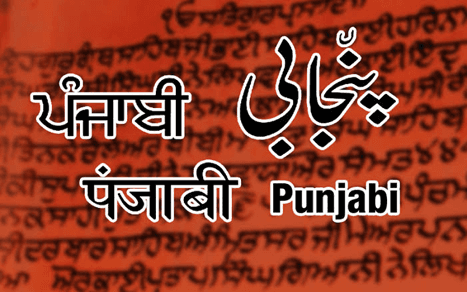
Punjabi is spoken in a variety of dialects across Pakistan's Punjab, and the Indian states of Chandigarh and Haryana, with each dialect reflecting the distinct cultural identity of its respective Doaba (land between two rivers). It has approximately 150 million native speakers, with 88.9% in Pakistan and the remainder in India, Canada, Gulf States, the US and Europe (Glottolog, n.d.; Shackle, 2003). Punjabi language is written in two scripts: Shahmukhi is used in Pakistan and Gurmukhi in India (Shackle, 2003). Standard Punjabi is based on the Majhi dialect, which predominates in television, entertainment, and literary writings in Pakistan. Eastern Punjab, which includes Indian Punjab, Rajasthan and Haryana has dialects such as Majhi, Malwai, Doabi, Puadhi, and its extinct variant Lubanki. Western Punjab also has several dialects, which highlights the diversity of the language. Saraiki, Pahari-Pothwari, Hindko, Jhangvi, Shahpuri, Dhanni, and Thali are widely spoken in the northern and southern parts of Punjab.
The phonology of Punjabi shows variation in vowel usage across different dialects (Singla et al., 2007). Standard Punjabi has long vowels, which are used for close, near-close, close-mid, mid, open-mid, and open vowel qualities. Simple eeee, ooo, aaaa, aa can change entire meaning of a conversation. Moreover, Punjabi also uses nasal vowels, which attach to adjacent vowels to change the tone of speech. In Pakistani Punjab, Punjabi dialects also incorporate words from other neighboring languages, such as Nijh or nii from Sindhi, which demonstrates its interaction with other languages of the region (Shackle, 1993).
Punjabi is an Indo-Aryan language that uses three lexical tones: low, high, and level (high-falling, low-rising, and neutral or middle) (Shackle, 2003). 75% of Punjabi words are spoken in a level tone, while some words begin in a level tone and end in a falling tone. Punjabi has a canonical word order of SOV (subject–object–verb). Function words are postpositions that mark the grammatical case of a preceding noun. Punjabi distinguishes two genders (masculine and feminine), two numbers (singular and plural), and six cases (direct, oblique, vocative, ablative, locative, and instrumental) (Shackle, 2003; Zograph, 2023). The ablative occurs only in the singular, in free variation with the oblique case plus an ablative postposition, while the locative and instrumental cases are generally confined to fixed adverbial expressions.
Punjabi has borrowed words from Sanskrit, Persian, Arabic, Sindhi, and many other native languages (Bailey, 1919). Its three writing systems, Shahmukhi, Gurmukhi and Devnagri, reflect the influence of different linguistic traditions over time. Shahmukhi, based on the Perso-Arabic script, is associated with Muslims usage, whereas Gurmukhi and Devnagri, rooted in the Brahmanic tradition, trace their origins to ancient Indic scripts (Shackle, 2003).
The Vibrant Tapestry of Punjabi Culture
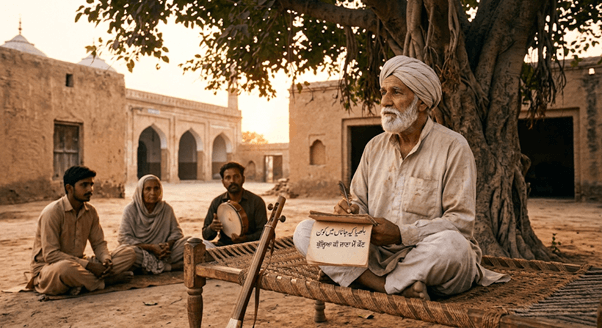
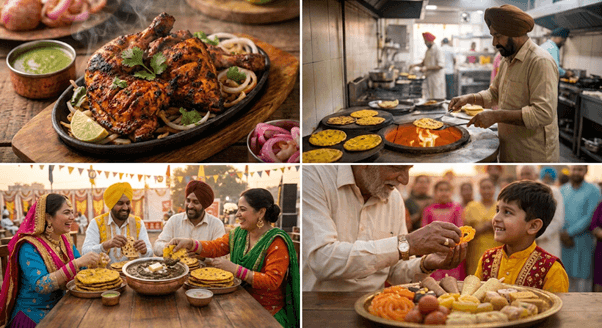
At the heart of Punjabi culture lies the concept of “Punjabiyat”— a term that captures the shared cultural spirit of the region (Malhotra & Mir, 2012). This identity transcends regional and religious boundaries, synthesizing influences from Sufism and Sikhism through values such as selfless service and social justice. The Punjabi language itself constitutes a pillar of this culture, with a poetic tradition shaped by renowned figures such as the 18th-century Sufi poet Bulleh Shah (Minami, 2023) and the modern romantic poet Shiv Kumar Batalvi (Singh, 2023), whose works explore the themes of love and spirituality.
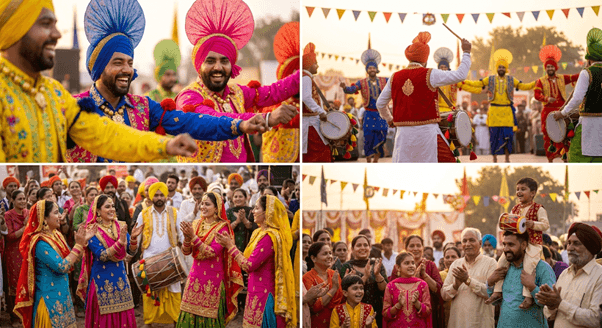
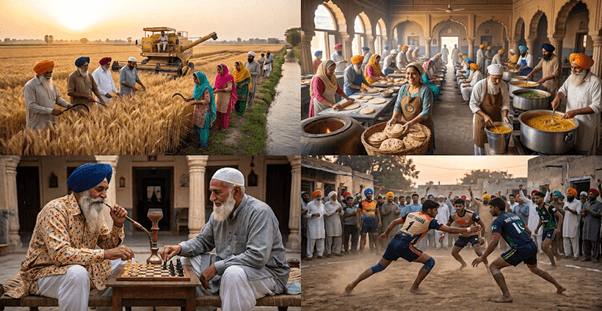
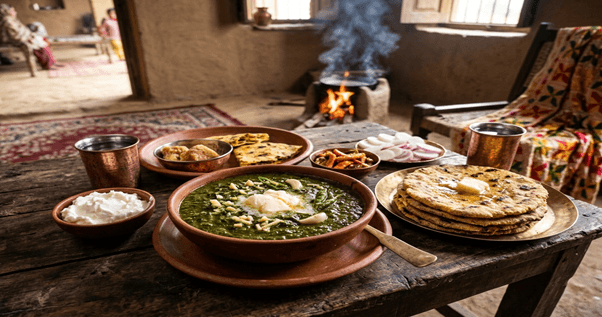
The culture is also renowned for its vibrant arts. The energetic dance of Bhangra, which originated as a harvest celebration, has become a global symbol of Punjabi joy. Traditional instruments, such as the powerful dhol (drum), and the soulful tumbi (a one-stringed instrument), are not merely folk relics but are now integral to modern pop music (Pande, 1999) by artists such as Diljit Dosanjh, Arif Lohar who plays chimta (tongs), and others who play ektara (also a one-stringed instrument). Punjabi cuisine, with its rich, buttery flavors, is another hallmark of the culture. Dishes such as Sarson da Saag and Makki di Roti are winter staples, while the tradition of langar (community kitchen) in Sikh gurdwaras demonstrates how food is central to community life. In terms of dress, women often wear beautifully embroidered Phulkari shawls with Shalwar Kameez, while men wear Lungi Pajama often topped with a distinctive turban.
Festivals bring these vibrant traditions to life. Celebrations such as Lohri, with its winter bonfires, and Baisakhi, the spring harvest festival, are occasions for music, dance, and community feasting. Finally, the Punjabi diaspora plays a key role in sustaining this culture (Taylor, Singh and Booth, 2015). Having migrated worldwide since the 19th century, overseas Punjabis maintain their traditions while adapting to new societies, creating a living link between their homeland and the rest of the world. In all its forms, from poetry to celebrations, Punjabi culture remains a powerful story of resilience, hospitality, and enduring identity.
Writers and Poets of the Punjab
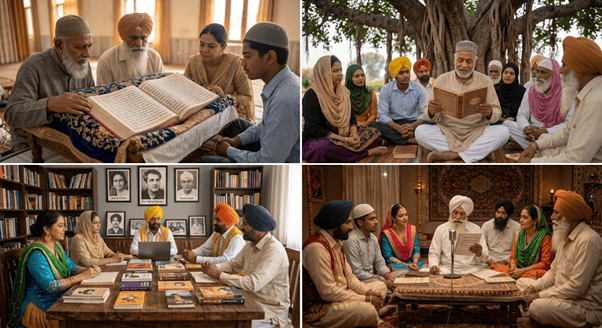
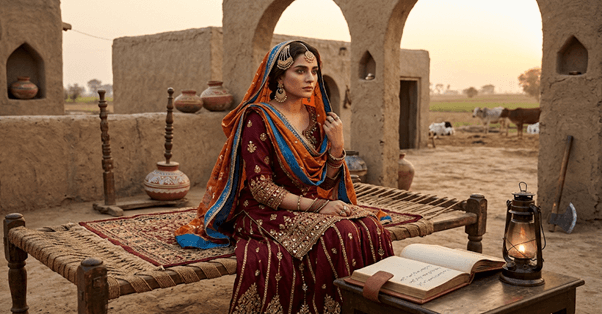
The Punjabi literary tradition is profoundly shaped by the voices of Sufi mystics, whose verses continue to resonate across centuries. Central to this stream are poets like Shah Hussain (16th century) and Bulleh Shah (17th–18th century), who developed the poetic genre of the kāfī, a vernacular medium for expressing complex mystical and philosophical ideas (Latif & Akhtar, 2024). Bulleh Shah's poetry is noted for its deep engagement with the concept of religious symbiosis, critiquing institutionalized authority in both Hinduism and Islam while emphasizing a personal, devotional connection to the divine (Minami, 2023). The evolution of kāfī from Shah Hussain to the 19th-century poetess Piro Preman demonstrates the form’s remarkable resilience and dynamism, attesting to the vibrant, lived history of Punjabi literature outside formal courtly or religious institutions (Latif & Akhtar, 2024).
Another monumental figure who consolidated Punjabi’s place as a literary language is Waris Shah (1722–1798), best known for his seminal work, Heer. Composed around 1766, this tragic romance of star-crossed lovers, Heer and Ranjha, serves as a cultural encyclopedia of 18th-century Punjab, vividly capturing its customs, social norms, and pastoral life. The work emerged from a particular social and political context in which Punjabi literature flourished not in courts but at the peripheries, gaining popularity among the masses (Malhotra & Mir, 2012). The enduring power of Waris Shah’s narrative is exemplified by its later invocation during the trauma of the 1947 Partition, when the poet Amrita Pritam famously addressed him in her poignant poem, “Ajj Aakhaan Waris Shah Nu”, calling upon his spirit to witness the carnage that had devastated their beloved Punjab (Nandrajog & Srivastava, 2023).
The modern era of Punjabi literature is marked by a turn toward introspective romanticism and social realism, particularly in the works of figures such as Shiv Kumar Batalvi and Amrita Pritam. Shiv Kumar Batalvi (1936–1973), often called the “John Keats of Punjab”, is renowned for his intensely passionate poetry that explores the themes of separation, agony, and the sorrows of the middle class, earning him the moniker “Birha da Sultan” (King of Sorrow). In parallel, Amrita Pritam (1919–2005) emerged as a pioneering voice who gave unprecedented expression to the realities of women’s lives (Nandrajog & Srivastava, 2023). Over a six-decade career, she produced over 100 books of poetry, fiction, and autobiography, consistently subverting patriarchal structures. Her work, including the novel Pinjar (The Skeleton), forms a crucial part of postcolonial studies for its portrayal of the gendered trauma of Partition, solidifying her legacy as a writer who captured the fractured psyche of a nation.